


USMCA Signal: North American auto integration meets political uncertainty.
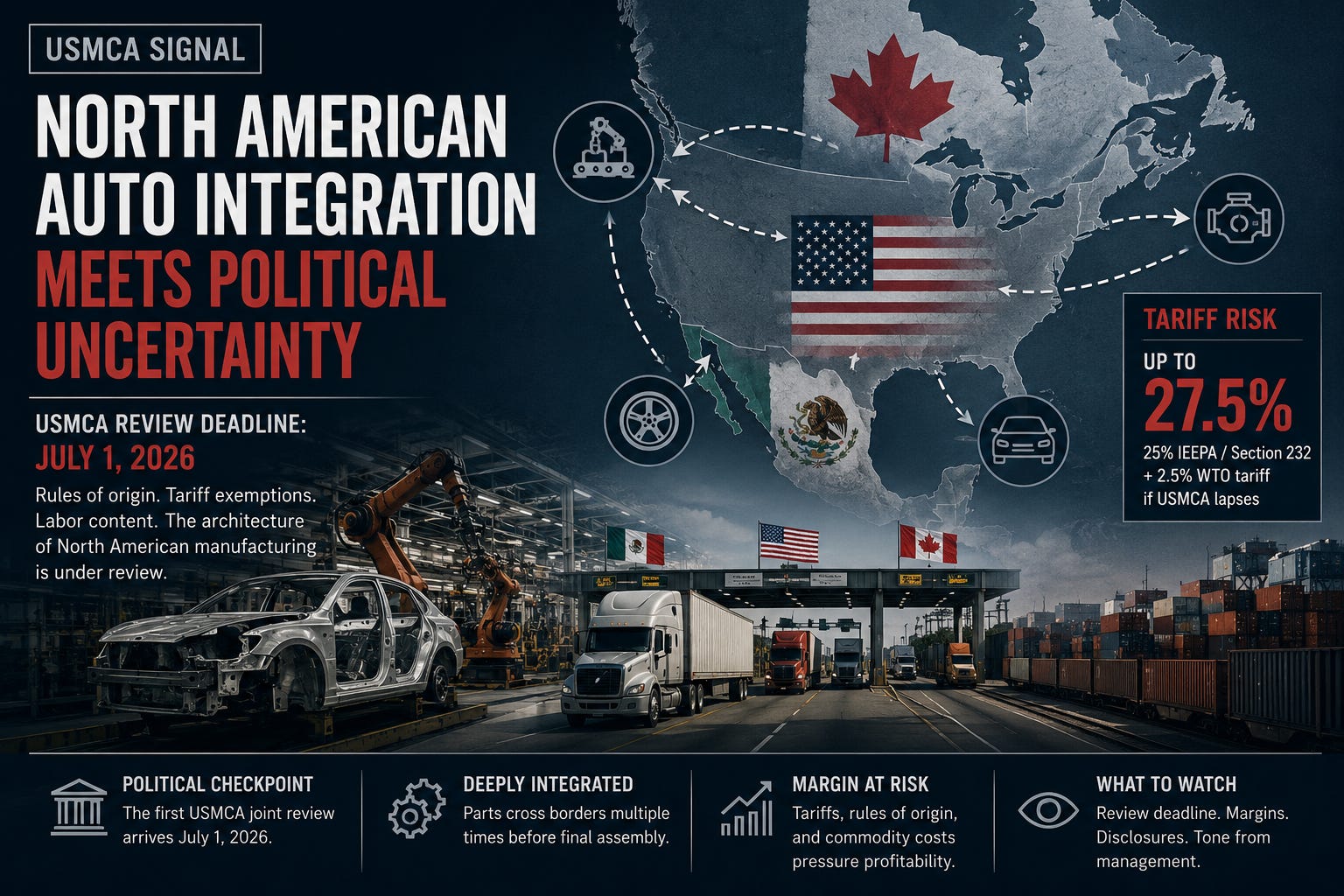
GM is not just exposed to the USMCA review.
It is one of the clearest tests of whether North American auto integration can survive a more politicized trade regime.
The issue is simple. GM’s supply chain was built for a continent. The politics around that supply chain are becoming national again.
For decades, the operating assumption behind North American autos was that capital, components, vehicles, labor inputs, and suppliers could be organized across the United States, Mexico, and Canada under a relatively stable trade framework.
That assumption is now under review.
The first formal USMCA joint review arrives on July 1, 2026. The deadline does not automatically end the agreement. But it does create a live political checkpoint over rules of origin, tariff exemptions, labor content, and the broader architecture of North American manufacturing.
For GM, this is not abstract.
The company operates major plants in Mexico and Canada. Engines, transmissions, stampings, components, and finished vehicles move across borders inside a deeply integrated production system. That system was not designed for annual tariff uncertainty.
The bull case, from an investor perspective, is that GM has buffers.
The company reported Q1 2026 revenue of $43.6 billion and net income of $2.6 billion. Management guided to full-year net income of $9.9 billion to $11.4 billion. Its North America margin target points back toward the 8–10 percent range. GM Financial remains a meaningful earnings stabilizer. And the company has already been restructuring around EV exposure, cost pressure, and profitability discipline.
In other words, GM is not passively absorbing the tariff shock. It is adapting.
That matters.
The bear case that some investors see is that adaptation may not be enough if the rules themselves keep shifting.
A layered tariff regime, tighter rules of origin, commodity inflation, and annual USMCA uncertainty all compress the investment horizon for a company that makes 5–10 year capital commitments. Auto supply chains cannot be re-optimized every political cycle without cost.
That is the deeper issue.
The market tends to treat tariffs as a margin problem.
For GM, USMCA renegotiation is also a governance problem, a capital-allocation problem, and a supply-chain architecture problem.
The bull case wins, on balance, because GM has scale, legal capacity, financial buffers, North American pricing power, and some leverage in the negotiation itself. Washington may want more favorable terms, but it cannot easily unwind North American auto integration without raising costs for U.S. consumers and disrupting domestic supply.
The bears do still own the sharpest single argument.
GM’s North American model was built around integrated continental production. If that model becomes subject to recurring tariff recalibration, the company’s strategic planning problem becomes much harder.
So the story is not:
“Tariffs are bad for GM.”
The story is:
GM may be profitable enough to absorb this round of trade friction. But the political architecture underneath its North American operating model is becoming less stable.
That makes GM a useful signal.
Not just for autos.
For the wider question of whether North American industrial integration is being renewed, renegotiated, or slowly converted into a managed-friction system.
Watch the July 1 USMCA review.
Watch Q2 margins.
Watch any management language around Mexico, Canada, rules of origin, and tariff cost recovery.
And most of all, watch whether GM talks about this as a temporary policy cost or a structural operating condition.
That distinction is the signal.