



Carl von Clausewitz fought in the Napoleonic Wars and spent the remainder of his life trying to understand what he had witnessed. On War, published posthumously in 1832, remains the foundational text of Western strategic thought. He wrote about the irreducible complexity of conflict — the fog, the friction, the limits of intelligence, the primacy of politics over military logic. His central argument was that no plan survives contact with reality intact, and that the purpose of theory is not to eliminate uncertainty but to train the mind to act within it.
Two centuries later, his observation about knowledge and uncertainty has acquired a new register. The volume of geopolitical noise reaching national leaders and corporate decision-makers alike has never been greater. The analytical challenge for company executives — discerning the signal in that noise that represents firm-specific exposure, in real time, at decision-relevant resolution — has never been harder.
Many executives are experimenting with tools such as ChatGPT and Claude to help parse signal from noise. That instinct is sound.
But the real potential for AI to improve geopolitical decision-making inside firms lies elsewhere: in the emerging practice of building corporate digital twins that represent a company’s actual exposure to the geopolitical system.
These systems are not designed to replace human judgment. Their purpose is simpler. They help organizations structure an internal conversation about two questions:
what they believe about the world
how they believe they are positioned within it
AI will not eliminate geopolitical uncertainty.
What it can do is help firms reason about their exposure to that uncertainty more systematically.
Modeling Geopolitics with AI
Recent advances in artificial intelligence — particularly the emergence of agentic systems — make it possible to approach this problem in a more structured way.
Earlier large language models responded to individual prompts. Agentic architectures extend that capability. They can pursue defined analytical tasks over time: gathering information, updating their internal understanding as conditions change, and using tools to reason through problems.
Applied to geopolitics, this creates the possibility of maintaining a continuously updated representation of two things simultaneously:
the geopolitical environment itself
the specific ways a firm is exposed to it
The objective is not prediction in the narrow sense. It is to give organizations a disciplined way to explore how geopolitical developments could interact with their own strategy and operations.
In practice, this requires building two complementary models.
The first represents the external geopolitical environment.
The second represents the firm itself.
These are commonly described as a world model and a corporate digital twin.
When the two are connected, organizations can begin to test how geopolitical developments might propagate through their own operational architecture.
How the System Works
At a high level, the architecture has three components.
1. A World Model
A continuously updated representation of the geopolitical environment — states, alliances, competitors, suppliers, sanctions regimes, regulatory structures, and conflict dynamics.
2. A Corporate Digital Twin
A structured model of the firm itself — its assets, supply chains, regulatory exposure, financial dependencies, and government relationships.
3. A Simulation Layer
A system that allows the two models to interact, so geopolitical developments can be tested against the firm’s operating architecture.
In effect, the system asks a structured question:
If the geopolitical environment changes in a particular way, how does that change propagate through the firm?
The answer is not a generic risk score. It is a firm-specific assessment of operational exposure.
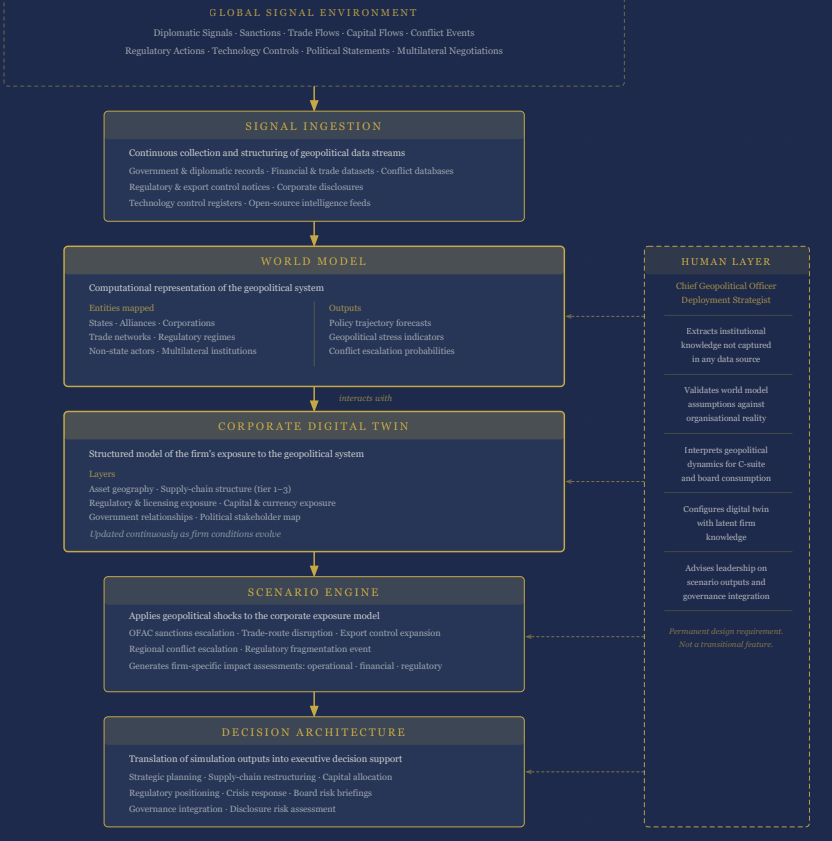
The World Model
The first component is a structured model of the geopolitical environment.
This is not a news feed. It is a continuously updated representation of the relationships that shape international political and economic behavior: relations among states, alliances, competitors, suppliers, sanctions regimes, regulatory jurisdictions, trade dependencies, and conflict dynamics.
The model draws on data sources that already exist but are difficult for any human team to track simultaneously. These include diplomatic statements, sanctions notices, legislative actions, trade flows, financial data, conflict event records, and regulatory announcements.
Rather than presenting this information as commentary, the model organizes it analytically.
It tracks relationships among actors and identifies patterns indicating where policy pressure is building, where regulatory divergence is emerging, or where geopolitical tensions may be escalating.
The result is a structured picture of how the geopolitical system is evolving across domains such as trade policy, sanctions regimes, technology controls, and security competition.
This is the external half of the architecture.
The Corporate Digital Twin
The second component is a model of the firm itself.
Every globally exposed company operates through a complex architecture of geopolitical exposure. Production assets sit in specific jurisdictions. Supply chains depend on networks of suppliers across multiple tiers. Revenues are generated in different markets. Capital is raised in particular financial systems. Regulatory approvals are held in specific jurisdictions.
Much of this information already exists inside the organization. What is usually missing is a way to assemble it into a single analytical picture.
The corporate digital twin does exactly that.
It organizes the firm’s exposure across several dimensions:
geographic distribution of assets and facilities
supplier networks and supply chain concentration
regulatory exposure across jurisdictions
financial exposure across markets and currencies
relationships with governments and regulators
The result is not an industry benchmark. It is a firm-specific map of how the organization interacts with the geopolitical system.
As conditions change — new suppliers, new markets, regulatory shifts — the twin can be updated to reflect the firm’s evolving configuration.
The Simulation Layer
Once both models exist, they can be used together.
This allows organizations to examine how specific geopolitical developments might affect their operations.
A scenario might examine:
sanctions escalation against a jurisdiction
disruption of a major shipping corridor
regulatory divergence affecting a critical technology input
The scenario is first applied to the world model, representing how the geopolitical environment might respond. The resulting changes are then mapped onto the corporate digital twin to assess how the firm’s assets, supply chains, and regulatory exposures could be affected.
The output is not a generic risk score.
It is a structured assessment of how a geopolitical development could propagate through the firm’s operations.
The breakthrough is not AI analysis of geopolitics.
It is the ability to connect geopolitical developments directly to the operating architecture of a specific firm.
The Human Layer
Even in this architecture, human judgment remains essential.
Some of the most important information about a firm’s geopolitical exposure does not exist in any dataset. It resides in the experience of executives and operators: informal supplier relationships, regulatory sensitivities, political dynamics in key jurisdictions, and institutional memory about past crises.
Capturing this knowledge requires structured engagement with the organization.
This is the role of the Deployment Strategist, a function well-suited for a Chief Geopolitical Officer.
That role involves translating geopolitical developments into firm-relevant exposure assessments, integrating internal knowledge into the digital twin, and communicating analytical results to executives and boards in decision-relevant terms.
AI provides scale — the ability to ingest and structure vast quantities of geopolitical information.
What it cannot provide is institutional judgment: the understanding of how geopolitical developments intersect with a firm’s strategy, assets, relationships, and governance obligations.
In practice, that responsibility requires a function capable of translating geopolitical dynamics into decisions the firm can act on — and stand behind.