


Geopolitics is no longer background noise for globally exposed firms. It now ranks as the most significant global risk facing enterprise leaders. This piece outlines a six-layer artificial intelligence (AI) powered architecture for embedding geopolitics into disciplined enterprise decision-making.

Still Life with Cake, Lemon, Strawberries, and Glass,1890, John Frederick Peto
Geopolitics is harder to quantify than financial performance and less amenable to standardized metric and so has largely remained outside the structured decision systems that govern modern corporations. It has been briefed, forecasted, debated—but not systematized. As sanctions regimes expand, industrial policy reshapes competitive landscapes, trade relationships fragment, and regulatory sovereignty reasserts itself, geopolitics has shifted from background context to operating condition. The World Economic Forum’s Global Risks Report 2026 ranked “geoeconomic confrontation” as the most significant global risk facing the year ahead—placing geopolitical rivalry above climate, inflation, and technological disruption. For enterprise leaders, the signal is unmistakable: geopolitics now sits at the top of the global risk hierarchy.
For most of the past decade, large companies have invested heavily in systems that bring structure to uncertainty. Revenue forecasts update dynamically as data flows through integrated planning platforms. Treasury monitors liquidity exposure in real time. Supply chain dashboards flag bottlenecks before production slows. Cyber and counterparty risks surface in executive dashboards instead of quarterly binders.
The modern corporation operates inside infrastructure designed to discipline decision-making. Now, armed with AI, corporate planners are attempting to impose similar analytical structure on the more elusive domain of geopolitics—feeding internal data into enterprise systems, stress-testing exposure, and modelling potential escalation pathways at speed and scale.
The early response has centered on AI-powered foresight. In-house teams are loading strategy documents into enterprise AI systems and asking geopolitical “what-if” questions. Start-ups are building geopolitical foresight engines and actively courting both investors and corporate clients. These systems ingest political data, monitor regulatory developments, simulate sanctions expansion, model tariff escalation, and generate probabilistic outlooks at scale. Used with discipline, they compress analytical timelines, expand situational awareness, and produce structured scenario frameworks.
But foresight—even AI-powered foresight—is not decision architecture.
With today’s tools, anticipation is no longer the primary constraint. The constraint is accountable decision-making under persistent uncertainty. The relevant question is not simply “What might happen?” It is: “Given what might happen, how are we structured to decide?”
An AI-powered enterprise geopolitics tech stack addresses that question. It embeds geopolitics into the same disciplined environment that governs finance, capital allocation, liquidity and treasury management, regulatory compliance, and board-level risk oversight.
Six layers define the architecture.
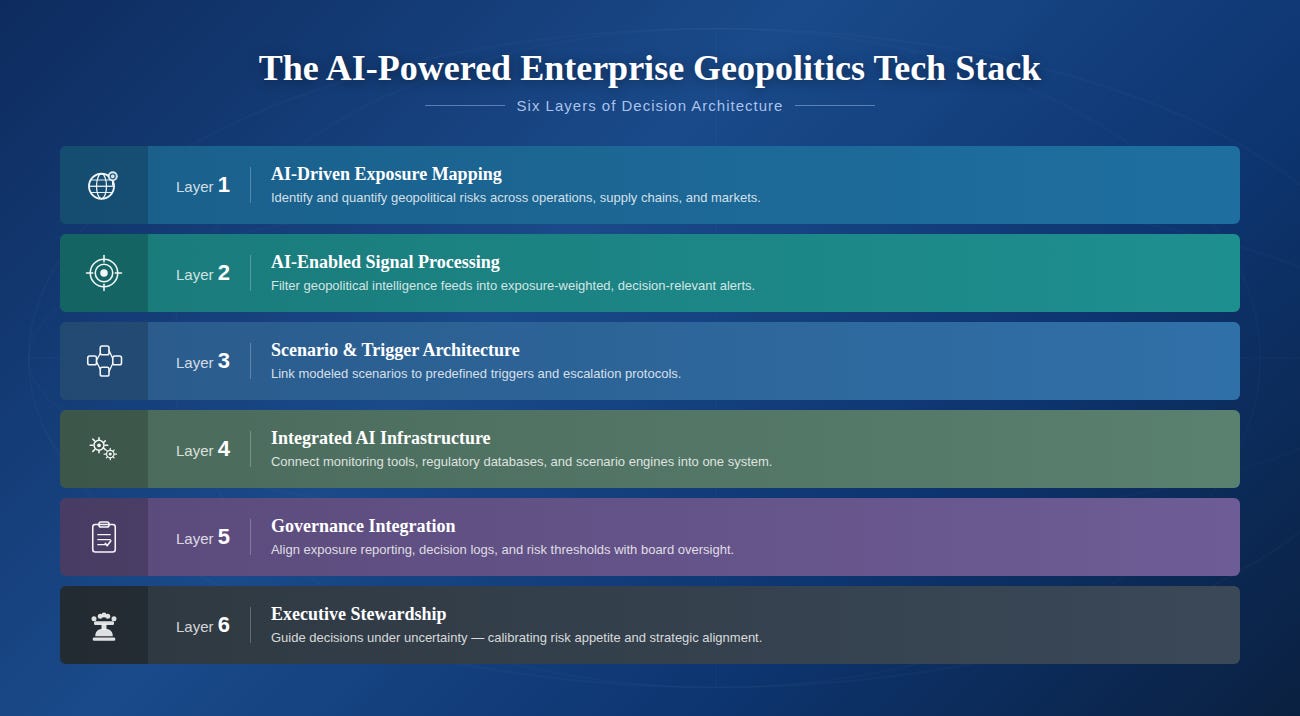
Layer One: AI-Driven Exposure Mapping
Most companies possess extensive operational and financial data but lack a coherent geopolitical overlay. An enterprise geopolitics stack integrates internal systems with sanctions databases, trade flows, licensing regimes, and jurisdictional risk indicators to produce dynamic exposure maps. Revenue concentration in sensitive markets becomes visible. Supply chain dependencies vulnerable to export controls are identified. Regulatory leverage points across jurisdictions are surfaced.
Large language models can parse legislation as it evolves. Machine learning systems correlate political developments with sector-specific intervention patterns—exposure shifts from being periodically reviewed to continuously recalibrated.
Geopolitics moves from anecdote to analytics.
Layer Two: AI-Enabled Signal Processing
Executives operate inside a permanent geopolitical information storm—elections, regulatory drafts, sanctions updates, and industrial policy announcements. AI can ingest thousands of feeds, summarize developments, and detect early inflection points.
But signal only matters relative to exposure. A regulatory shift in one country may be immaterial to most firms yet decisive for another with concentrated market dependence. The stack must filter developments through mapped exposure. AI’s value lies not in generating more alerts, but in generating exposure-weighted alerts.
Noise decreases. Relevance increases.
Layer Three: Scenario and Trigger Architecture
AI can model margin compression under tariff expansion, simulate layered sanctions regimes, and estimate second-order supply chain effects. Yet modeling alone does not create readiness.
Scenarios become operational only when linked to defined triggers. Leadership must specify what constitutes confirmation and what action follows. AI monitors legislative calendars, enforcement trends, and policy language shifts. When predefined thresholds are crossed, escalation protocols activate. Decision rights are clarified in advance.
The objective is not prediction. It is preparedness.
Layer Four: Integrated AI Infrastructure
Monitoring tools, regulatory databases, scenario engines, and internal dashboards must operate as a connected system rather than isolated utilities. Data flows from external developments into internal exposure maps and governance reporting. Automation reduces latency. Pattern recognition surfaces correlations that siloed teams might miss.
At this stage, geopolitics begins to resemble other enterprise systems: continuously measured, modeled, monitored, and documented.
The stack can carry an organization a considerable distance. It can reduce surprise, accelerate response, and build institutional memory.
Layer Five: Governance Integration
Boards increasingly expect clarity about how geopolitical exposure is managed. An enterprise geopolitics stack feeds structured reporting into existing governance channels. Dashboards align geopolitical exposure with financial performance. Decision logs record the context in which material choices were made. Assumptions and thresholds are visible.
This does not eliminate uncertainty. It clarifies process. Directors do not demand perfect foresight; they demand disciplined judgment.
AI systems help maintain that discipline by preserving the informational record surrounding high-stakes decisions.
Layer Six: Executive Stewardship
Even fully integrated, the stack is nothing without executive stewardship.
AI can ingest data, model outcomes, detect triggers, and document process. It cannot weigh geopolitical exposure against long-term strategic ambition. It cannot balance reputational considerations against market opportunity. It cannot stand before a board and explain why persistence in a contested market was chosen over exit, or why capital was redeployed amid incomplete clarity.
As modeling grows more sophisticated, the complexity of choice increases. Someone must integrate cross-functional implications, calibrate risk appetite, and align geopolitical architecture with enterprise strategy.
In an era of structural fragmentation, geopolitics is no longer episodic risk. It is an enduring operating condition. The advantage will accrue not to those who predict best, but to those who institutionalize decision discipline—embedding geopolitical exposure into capital allocation, governance, and executive accountability.