


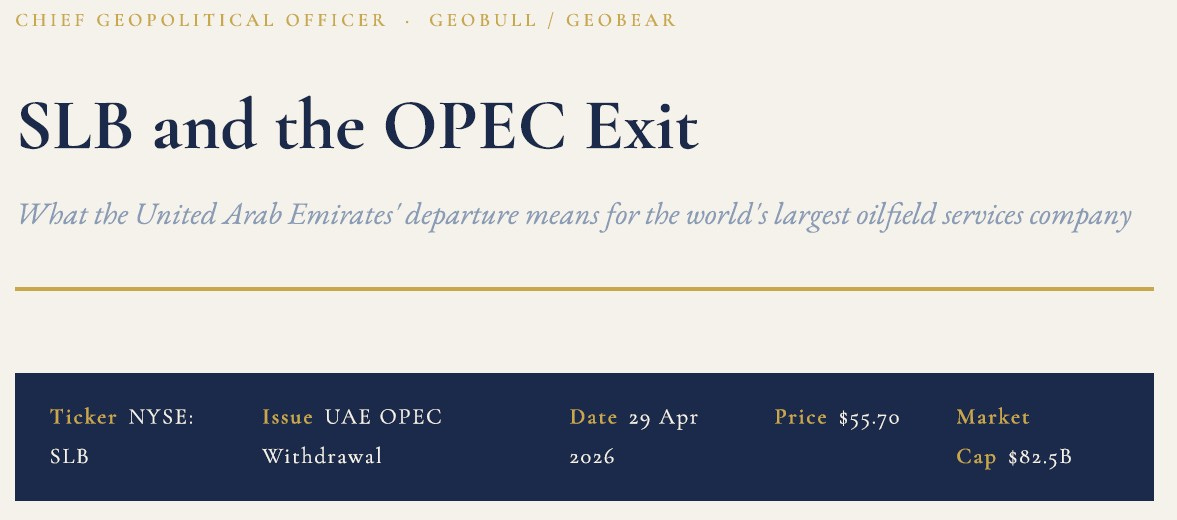
The United Arab Emirates walked out of the Organization of the Petroleum Exporting Countries on April 28, 2026. Effective May 1. No consultation with Saudi Arabia. No transitional period. Fifty-nine years of membership, terminated in a press release.
SLB — formerly Schlumberger, the name many in the industry still use — is the world’s largest oilfield services company. It generated $35.7 billion in revenue in 2025. Its Middle East franchise accounts for approximately $8.5 billion of that, or roughly 24% of total consolidated revenue. The UAE has been its fastest-growing country within that market. The Abu Dhabi National Oil Company, known as ADNOC, is not simply a client relationship. It is a structural partnership — a 30% equity stake in the Turnwell unconventional joint venture, an artificial intelligence platform called AiPSO already deployed across eight ADNOC fields and committed to all 25 by 2027, and more than 85 years of operational presence in the Gulf. When the UAE removes the quota ceiling on ADNOC’s production ambitions, that is not background noise for SLB. It is a direct operating environment change in the company’s most strategically embedded market.
GeoBull / GeoBear is the analytical format we use to work through exactly this kind of event. For each edition, we take a named public company and a named geopolitical trigger and build a structured two-sided debate — arguments for why the geopolitical setup creates upside, resilience, or competitive advantage, and five for why the same setup creates exposure, margin pressure, or strategic constraint. Every argument is sourced from open material: Securities and Exchange Commission filings, earnings call transcripts, primary policy documents, and official company releases. Disciplined reading of what firms disclose, and what they conspicuously do not. The full report on SLB, five arguments on each side, eight dated watch items with named decision triggers, and a CGO Read that identifies the governance gaps the board should be examining now, is available as a formatted PDF download.
The question is not whether SLB benefits from the UAE OPEC exit. The question is when, through which mechanism, and at what cost to the rest of its regional franchise. Because the same event that unlocks ADNOC’s production ramp also suppresses the oil prices that Saudi Arabia needs to sustain its own upstream spending, and Saudi Arabia is SLB’s largest single country exposure in the Middle East, one that contracted sharply in 2025 and has not recovered. The cartel cohesion that OPEC+ provided also kept Iraq, Kazakhstan, and Russia in relative supply discipline. The UAE departure weakens that discipline for everyone. If OPEC+ compliance erodes broadly, the resulting price environment compresses upstream capital expenditure budgets across SLB’s entire international franchise, not just in the Gulf.
And there is a more immediate problem. The Strait of Hormuz remains the binding constraint on every barrel ADNOC can now legally produce above quota. Tankers cannot transit freely. SLB’s first-quarter 2026 Middle East and Asia revenue fell 10% to $2.69 billion, driven by force majeure in Qatar, security shutdowns in Iraq, and offshore production constraints across the region, none of which the OPEC announcement resolves. The production unlock is real. Its timeline is logistics-gated, not policy-gated.
This is the analytical tension that makes SLB worth examining closely right now. There is a genuine bull case, structural, evidence-based, and grounded in disclosed contract relationships and financial data. There is an equally genuine bear case, also structural, also evidence-based, and pointing in the opposite direction through different channels.
Full report: