


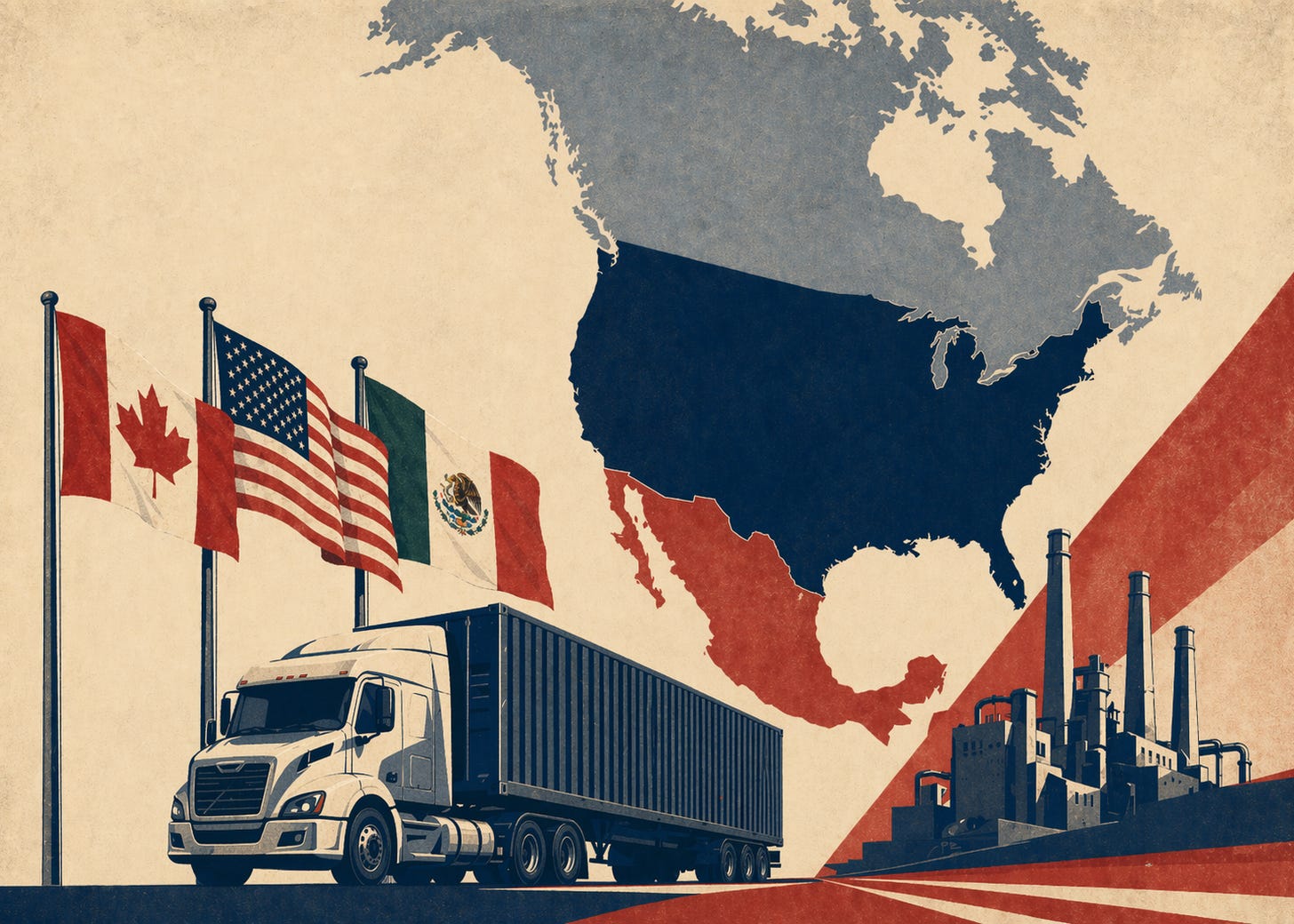
USMCA Signal is a new Chief Geopolitical Officer project focused on how companies are communicating about the 2026 review of the United States-Mexico-Canada Agreement.
Over the coming weeks, we will track how companies describe exposure to tariffs, rules of origin, sourcing, supply chains, Mexico manufacturing, Canadian supply, margin pressure and market access in earnings calls, filings, investor materials and press releases.
That communication is observable. It is attributable. And, with AI tools, it can be parsed for signal.
The United States-Mexico-Canada Agreement enters its first mandatory joint review on July 1, 2026.
That sounds procedural.
It is not.
July 1 is not a normal negotiating deadline. It is the formal start of a review process built into the agreement itself. If the parties agree to extend USMCA, the agreement continues. If they do not, USMCA does not immediately collapse. Instead, the agreement remains in force while the parties return to annual reviews, creating a shorter and more political planning horizon for companies that depend on North American trade certainty.
That distinction matters.
For companies, the risk is not only that USMCA ends. The more immediate risk is that long-term commercial assumptions become subject to recurring political recalibration.
This is a review of one of the most important trade relationships in the world. In 2025, U.S. goods trade with Mexico totaled about $872 billion. With Canada, about $719 billion. Combined, roughly $1.6 trillion in goods trade, more than U.S. goods trade with the entire European Union.
This is the operating system for North American commerce.
And the politics are already sharp.
In Ottawa on April 23, 2026, Canadian Prime Minister Mark Carney told reporters Canada was “not sitting here taking notes and taking instruction from the United States,” and that the review would “take some time.” That is not diplomatic hedging. It is a signal that Canada intends to resist the pace Washington is trying to set.
In Mexico City the day before, Economy Minister Marcelo Ebrard offered a different kind of realism. Companies, he said, should not be “nostalgic” about the zero-tariff era. Tariffs on automotive, steel and aluminum are likely to remain regardless of what the review produces. Mexico is not waiting to find out. It is recalibrating around the new baseline.
In Washington, the United States has been clearer about its own objectives. At the March 5 launch of the U.S.-Mexico review process, USTR set out the U.S. position around an organizing principle: ensuring that the benefits of the agreement “accrue primarily to the parties.” The mechanism is rules of origin: tightening regional content requirements, reducing dependence on inputs from outside North America, and making it harder for Chinese-linked production to enter the U.S. market through Mexico or Canada.
Three capitals. Three different postures.
Companies are caught in the middle.
Why this matters
USMCA replaced NAFTA in 2020. At the time, it was framed as a modernization.
Six years later, the context has changed.
Tariffs are no longer exceptional. They are part of the baseline environment. Industrial policy is back. China exposure is under scrutiny. Rules of origin are no longer technical clauses. They determine whether a product moves duty-free or gets caught in a tariff stack.
For companies, this shows up in practical terms:
Where is the product made?
Where are components sourced?
Does it qualify under USMCA?
Can costs be passed through?
Does a Mexico plant still carry the same advantage?
These are operating questions.
What happens next
Over the past year, a straight renewal has come to look increasingly unlikely.
The July 1 date still matters, but less as a cliff edge than as a hinge. It marks the beginning of the formal review process, not the end of it.
The more plausible path is not collapse. It is continuity with friction: continued talks, recurring annual pressure, and repeated attempts to renegotiate the terms of North American trade.
The agreement remains in force, but the horizon shortens.
For companies, that matters. Plants, suppliers, logistics networks and customer contracts are built on multi-year assumptions. A shift to annual political recalibration changes how those decisions get made, and when.
Where the signal appears
Most firms are not publishing geopolitical analysis. They are using standard corporate language.
Tariffs. Rules of origin. Mexico manufacturing. Canadian supply. Regional content. Cost pressure. Margin impact. Supplier qualification. Trade uncertainty.
That is where the signal is.
What this is, and what it is not
This is not a ranking.
It is not a comprehensive list of exposed companies.
It is a focused effort to identify and interpret signals: moments where companies reveal how geopolitical risk is entering the business.
The result will be a cross-sample of disclosures, intended to surface how these dynamics are playing out across different sectors and business models. The aim is not to predict the outcome of the review. It is to track where the effects are already visible.
Why this approach
North American trade is too large to treat as a specialist issue.
The United States trades more in goods with Canada and Mexico than with any other pair of countries. The agreement shapes everything from automotive supply chains to food, steel, medical devices, rail and consumer goods.
Yet most discussion of USMCA remains at the level of policy.
USMCA Signal flips the perspective, looking at the agreement through the companies that operate within it.
Bottom line
Companies are not describing geopolitics.
They are describing constraints on what they can produce, where they can produce it, and at what cost.
USMCA Signal tracks those constraints as they appear.